Boot tops

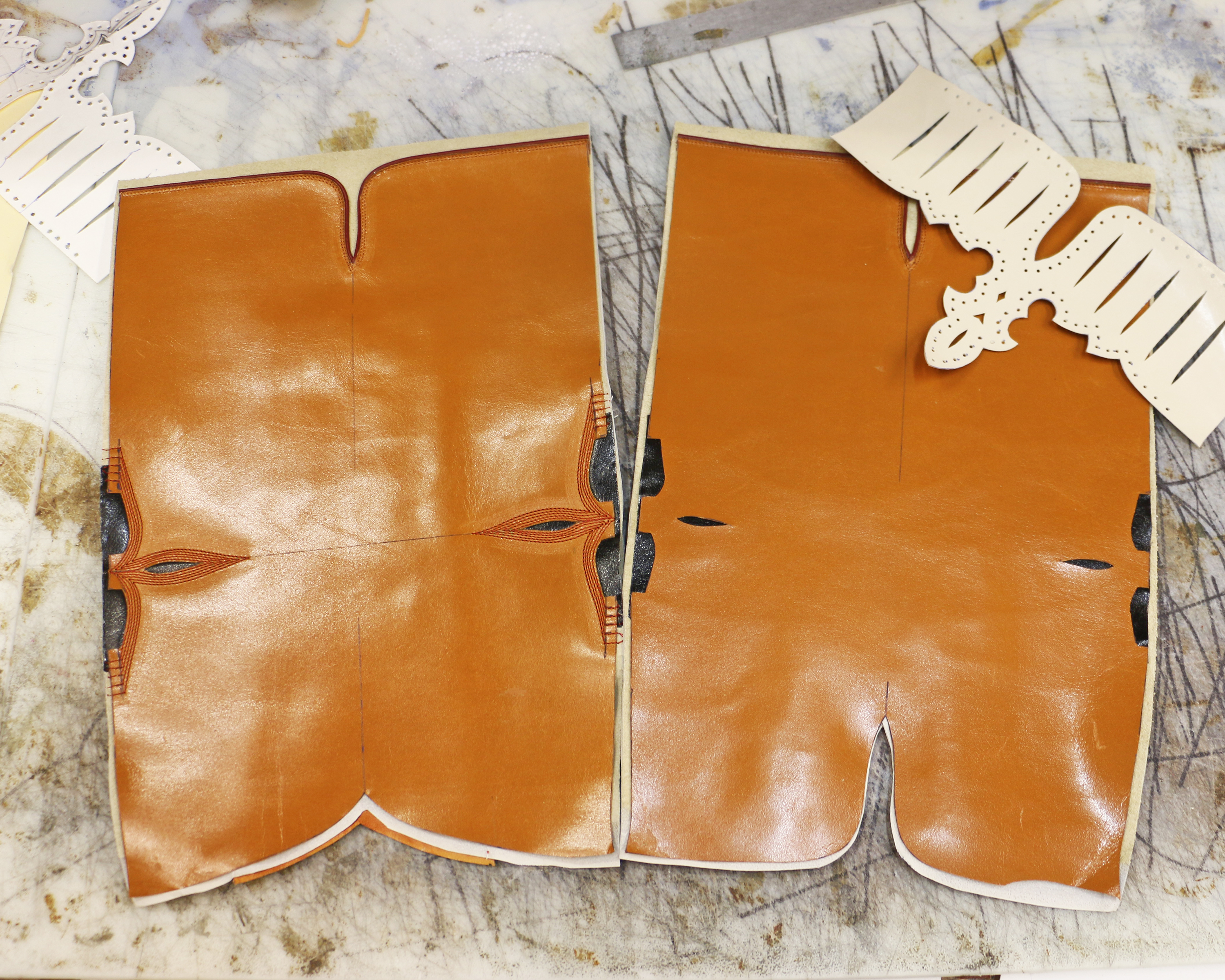
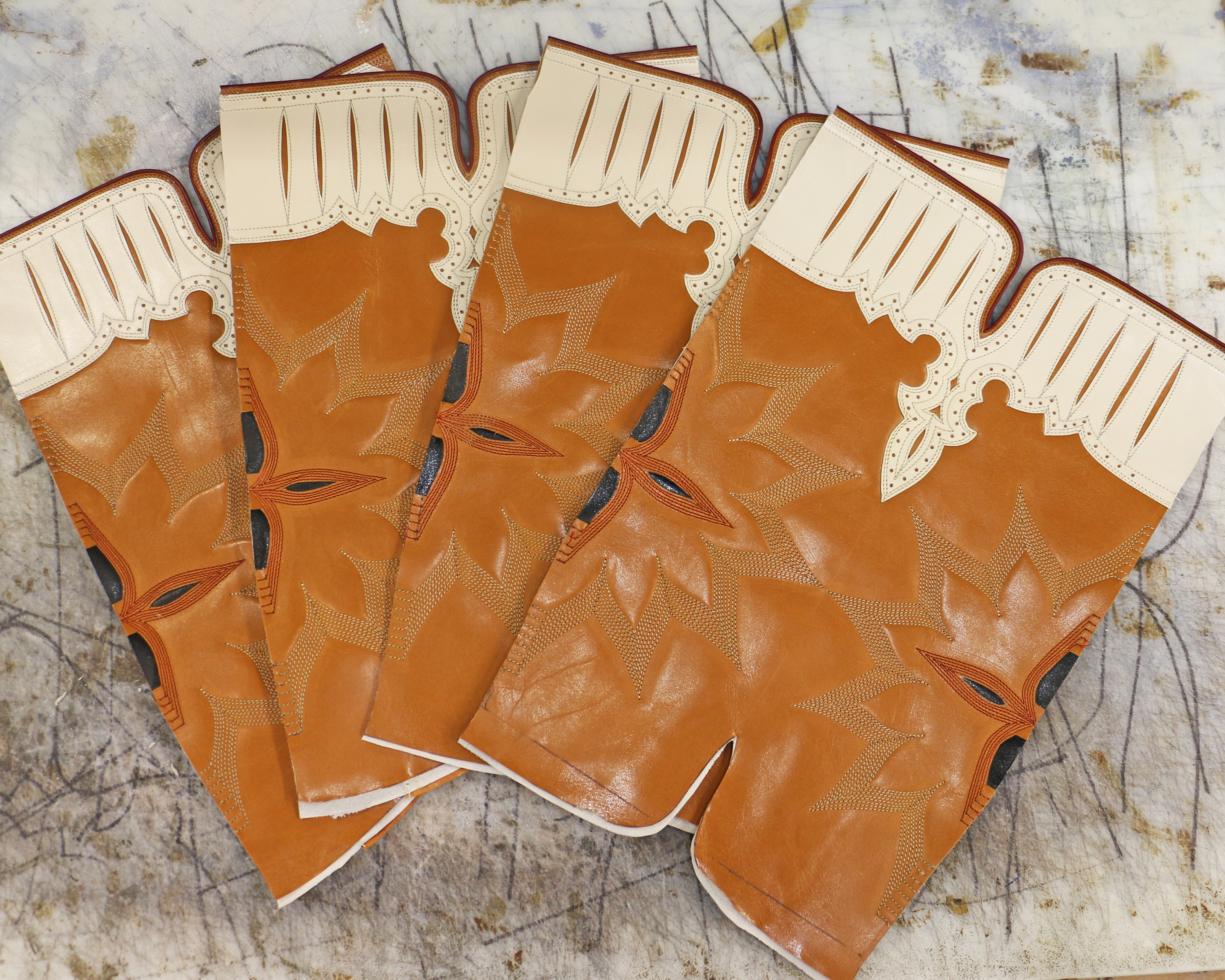
Completely stitched tops for the “Kansas City Star” boots
Posted in boot maker, Cowboy Boots | Tagged , , , , | Leave a comment

Kansas City Star

I would rate this design as Advanced. I don’t normally think of stitch patterns that way — either you can accurately sew a line of stitching right next to another one or you can’t — but this design has some challenges. 

Jay Griffith, my boot making mentor, designed this style and he called it #317. I never asked about his numbering system or understood it, so I’ve titled the design “Kansas City Star.”
I would guess this catalog is from the early 1960s, so in today’s dollars the boots would cost around $1800. Still too cheap in my opinion, but very much in line with what many boot makers charge today.
 I did five rows of stitching around the inner inlay. 
The large star has eight rows of stitching; before stitching the eight rows I draw contour lines to guide me as I’m stitching the points, so they all point in the correct direction and so that each eight-row point is exactly the same length. 
The challenges are: Multiple design elements have to accurately line up at the side seam or the entire design will be crooked. Also, keeping that Hershey Kiss shape/reverse curve through eight rows of stitching isn’t easy, because it wants to flatten. Jay always said that the best way to evaluate a top stitcher’s skill is to look at the boot top from the back, where you’re not distracted by color, so here you go. Evaluate away.
Posted in boot maker, Cowboy Boots | Tagged , , , , | Leave a comment

Whispering Hope

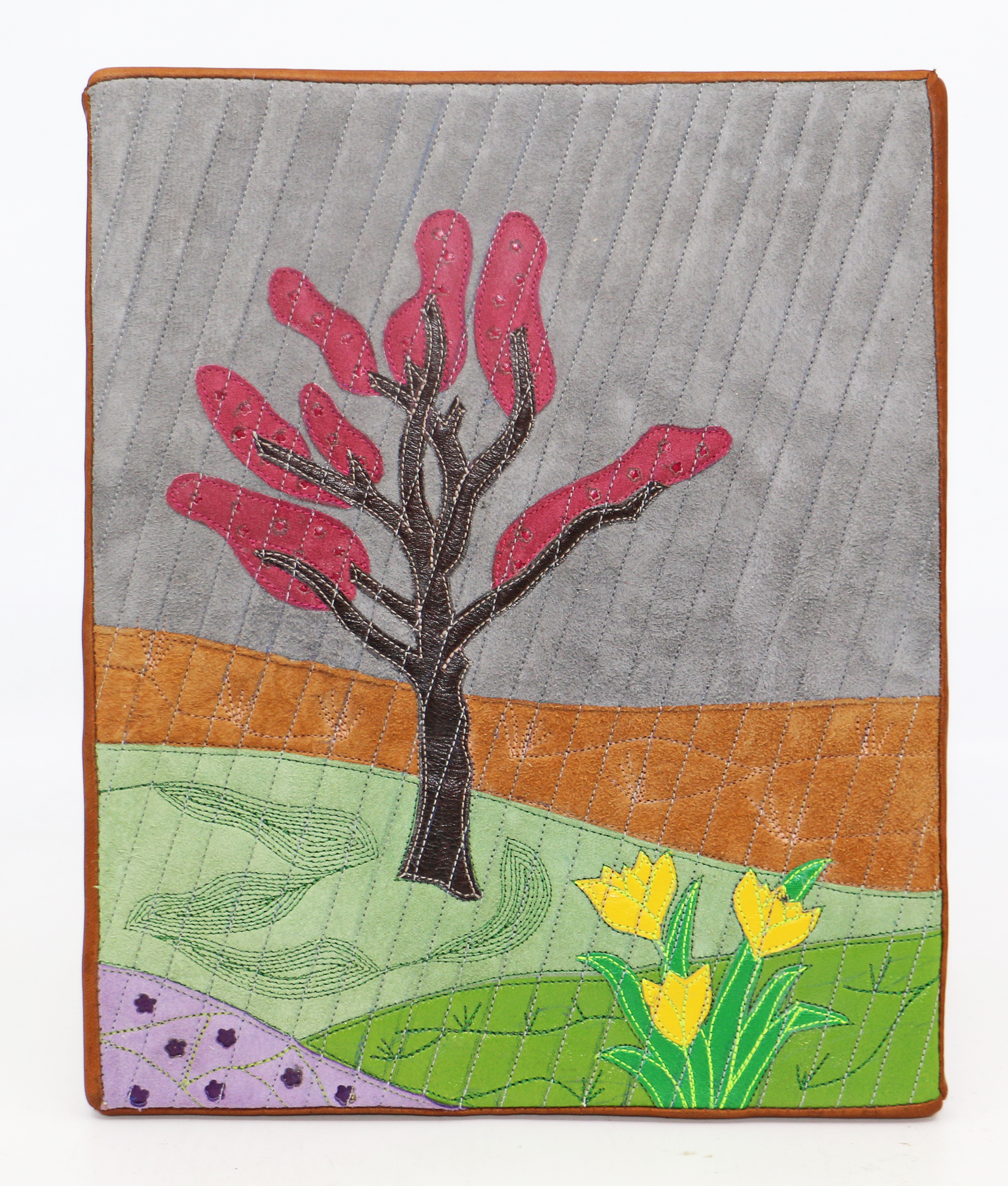
Another art piece, entitled “Whispering Hope”

This one was kind of scary because I did all of the inlay/overlay work successfully, then took a deep breath and stitched gray lines over all of it in the hope it would look like rain. It does, but since I’m doing a type of art that (as far as I know) no one’s ever done before, I’m never sure if the completed piece will match my vision. I love gray and drizzly days and I can almost smell the rain when I look at this piece.

I’m flying to an event in Idaho this weekend so I’m stretching my completed art pieces over stretcher bars. I’ll put everything I want to take into my suitcase and then if there’s space left I get to take some extra clothes; if not, look for me wearing the same thing all weekend. Once I return I’ll have everything framed nicely, which will cover up any unevenness around the edges.
Posted in boot maker, Cowboy Boots | Tagged , , , , | Leave a comment

Introducing: On Jordan’s Stormy Banks I Stand

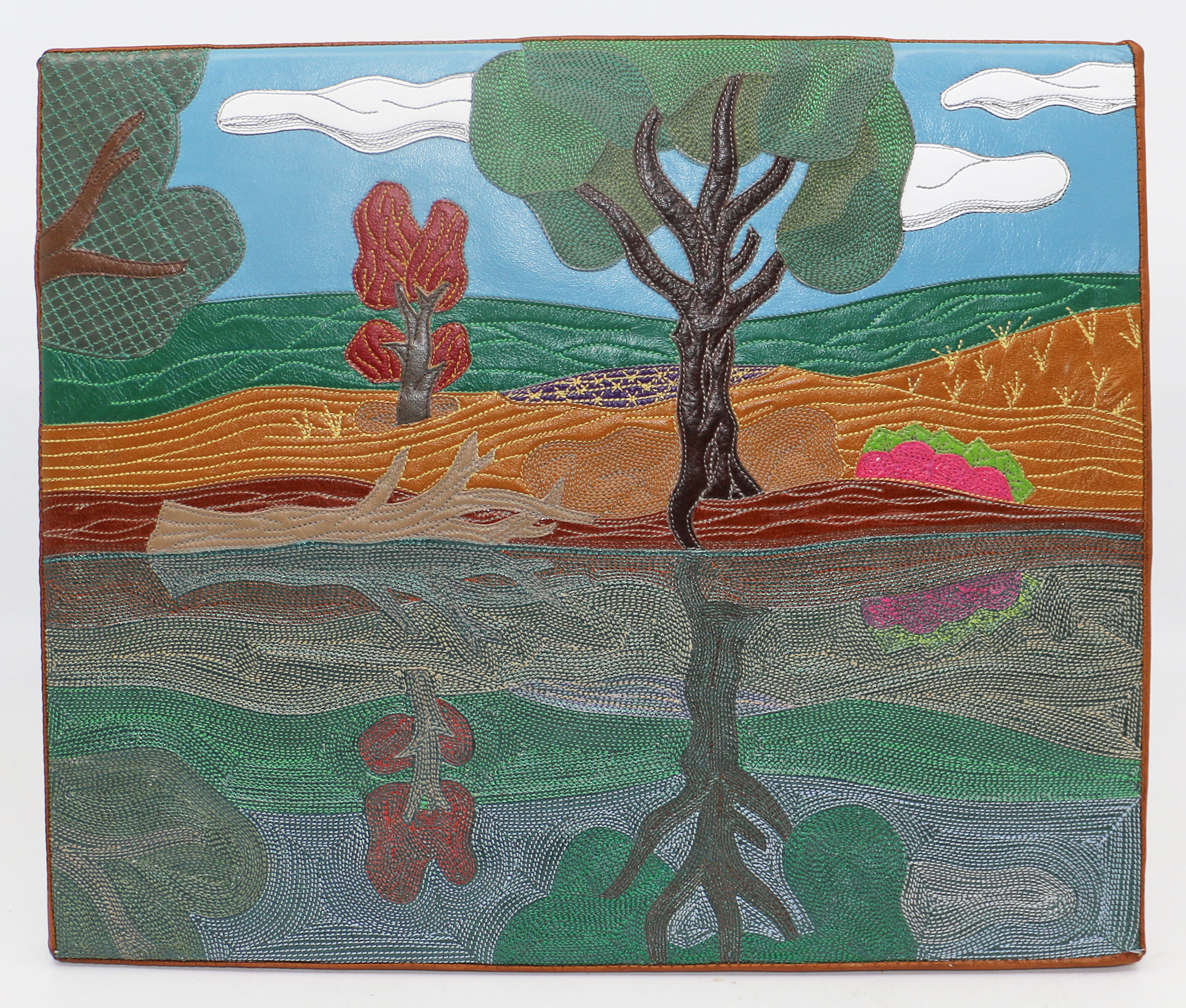
I tell my students that the ability to convey light and shadow with leather inlay/overlay is very limited, and it is, but I guess I’m a rebellious student who pushes against boundaries even when I’m the teacher. We have a beautiful pond next to our house and my favorite time of the day is early morning or late evening when the wind dies and the water is still and the pond perfectly reflects the land above it. I’ve always wished I had the ability to capture those moments but assumed that with my medium I could not — until recently, when I started thinking, “But what if I could? Is there anything I could do within my own craft to convey a reflection?”

Introducing: “On Jordan’s Stormy Banks I Stand”

The scene above the waterline is leather overlay, the reflection in the water is entirely stitching, done on my old non-computerized Singer 110W with its antique clutch motor.
Posted in boot maker, Cowboy Boots | Tagged , , , , | Leave a comment

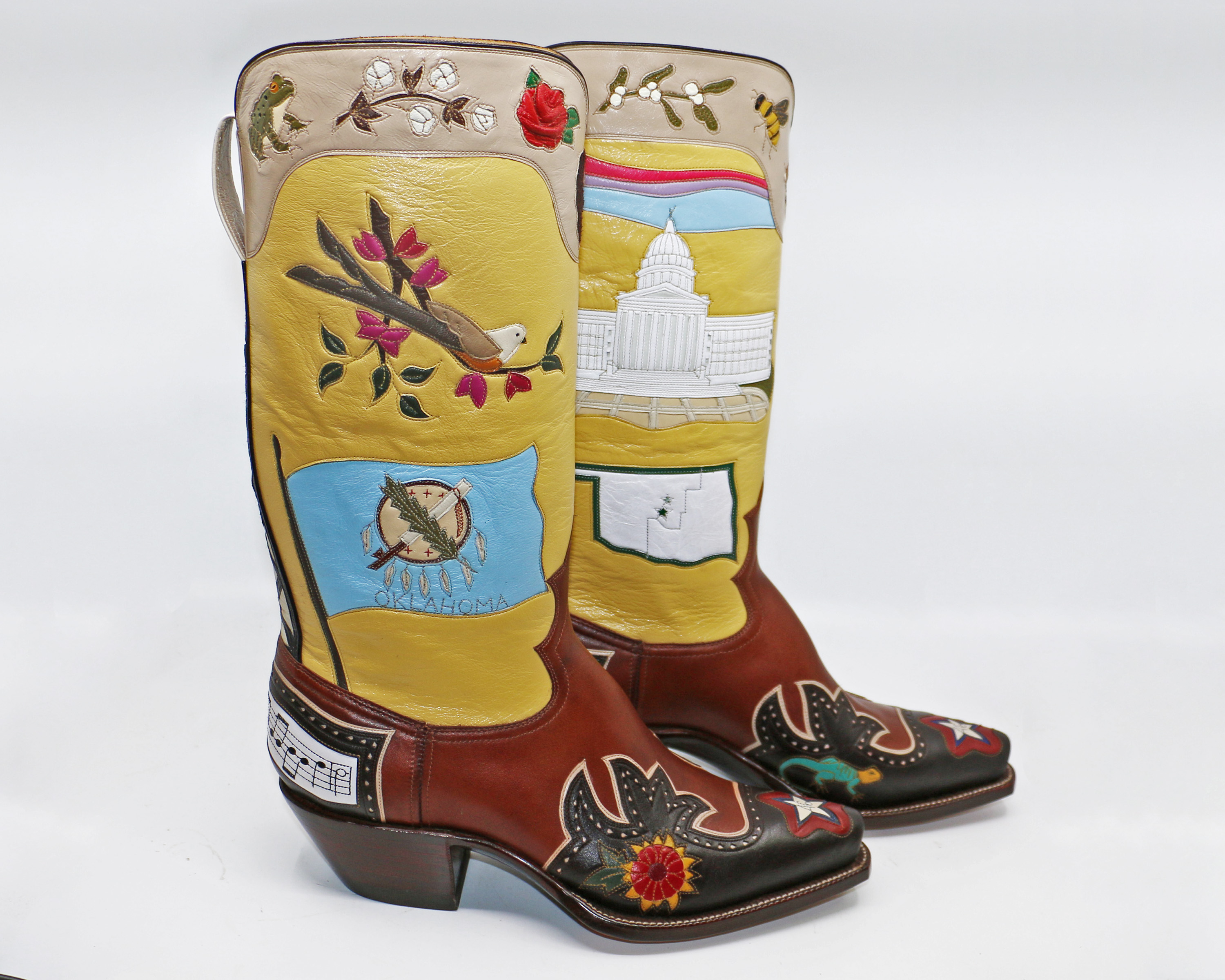
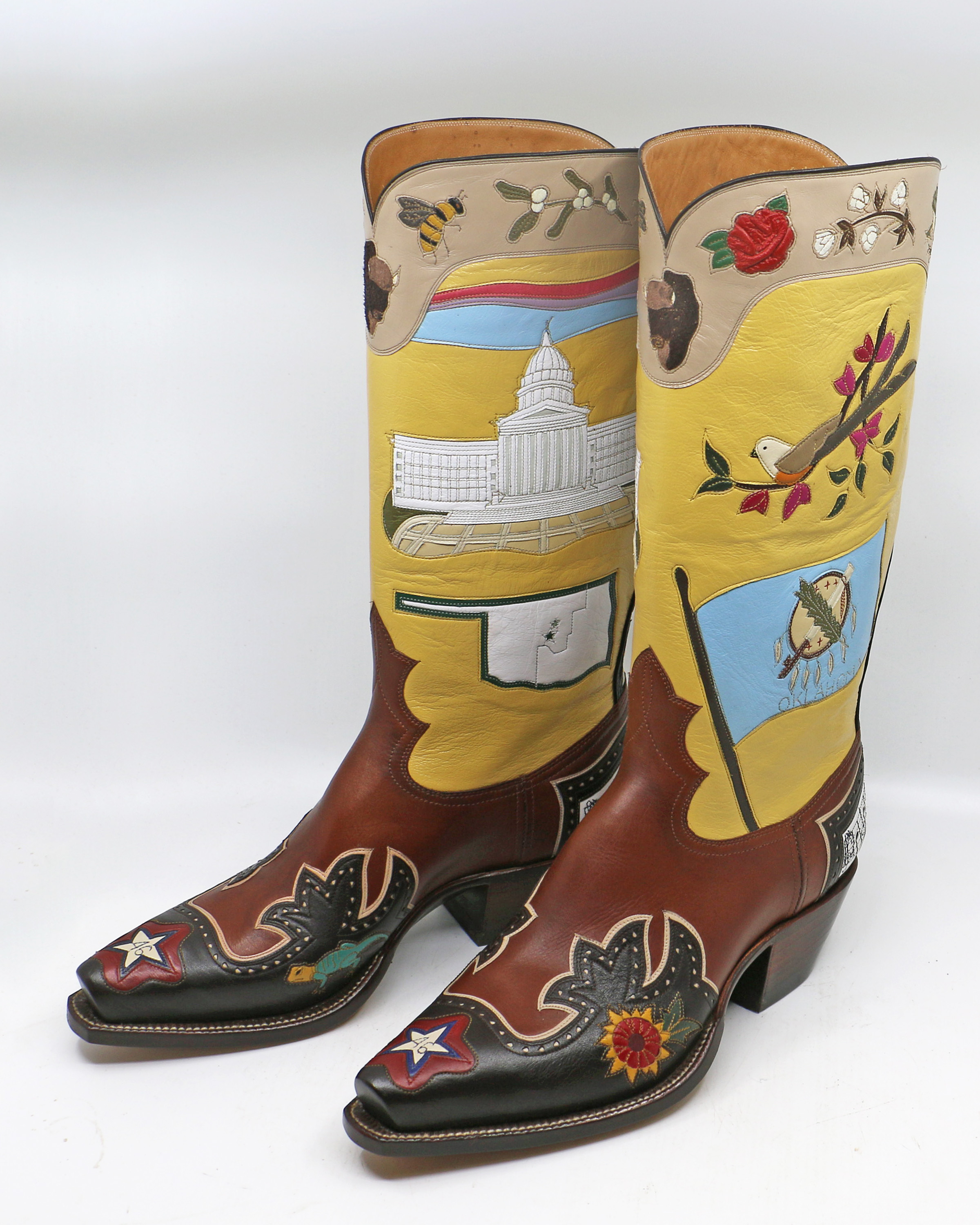
Introducing “This Land Is Your Land”

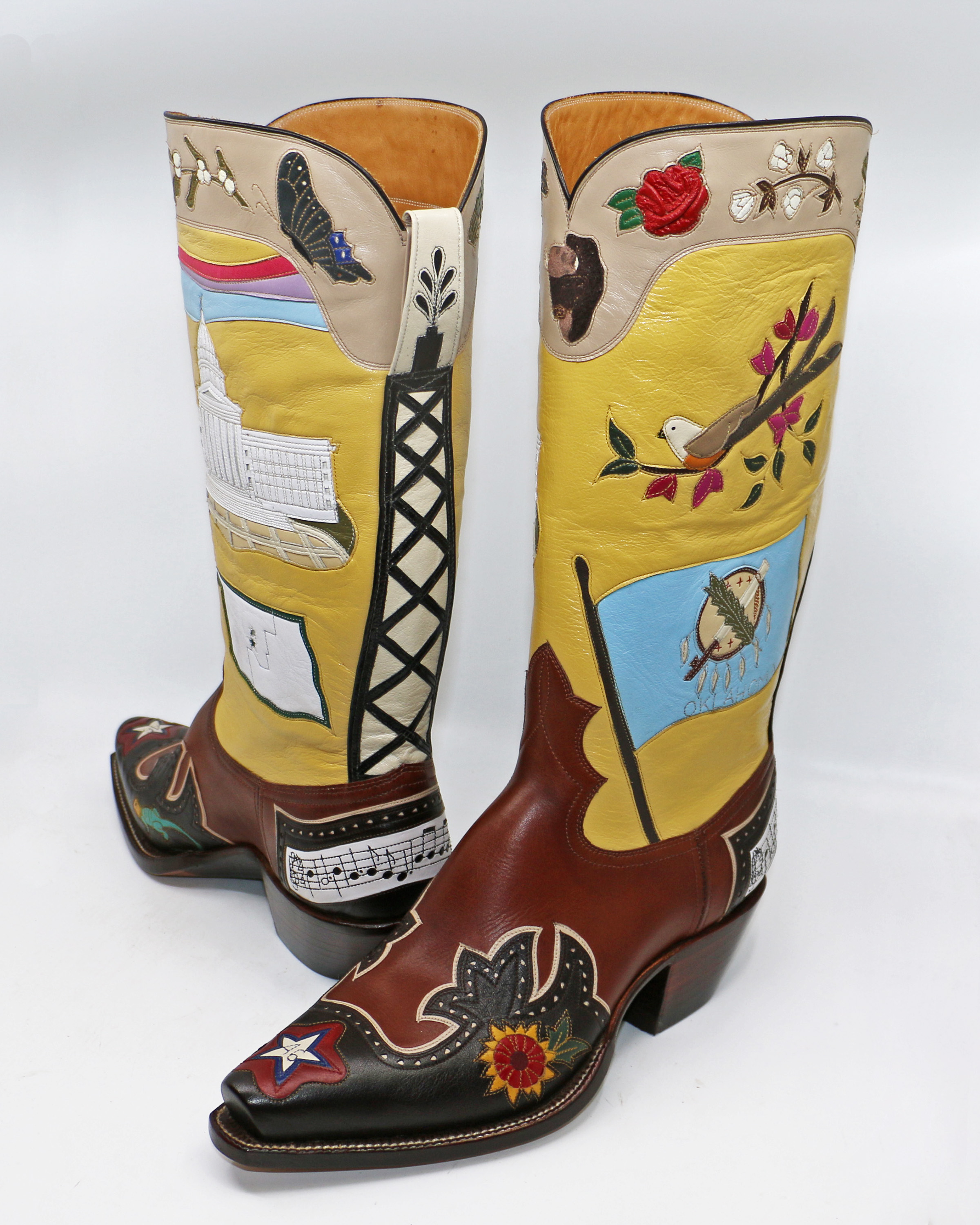
Day Eight, Final: Introducing “This Land Is Your Land”

Commissioned by the Oklahoma Arts Council, now part of the Oklahoma State Capitol permanent art collection

All of my boots are named after bluegrass and classic country songs, but I went slightly outside those genres with this song by Woody Guthrie, who was born and raised in Okemah, Oklahoma.
Posted in boot maker, Cowboy Boots | Tagged , , , , , | Leave a comment

Day Seven, Oklahoma State Boots

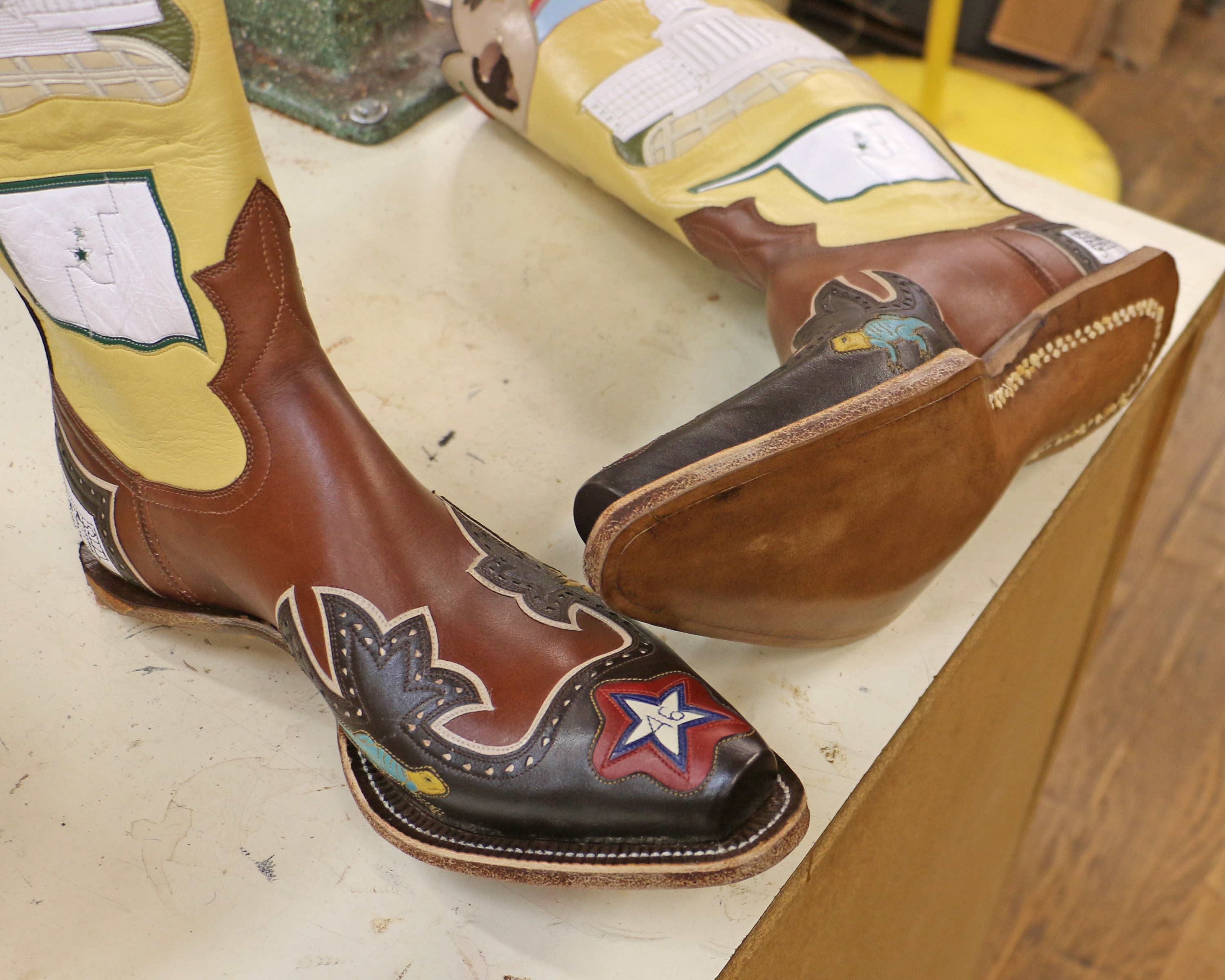
Today I’ll share the photos of how the boots were built so you can learn a little about cowboy boot construction.

When you look down at a cowboy boot and see stitching going around the toe, that stitching is not on the top of the sole. A narrow strip of leather called Welt is hand-stitched through the boot and also the insole. After the sole is added it’s stitched onto the welt, and this is the visible stitching you see. The Welt stitches, if they’re done properly, are completely invisible but they’re very important, as they’re what holds the top of the boot to the bottom. The metal shank is laced into the arch area with the excess threads from sewing the welt.
A cowboy boot traditionally has a rounded shank area, so I’ve covered the laced shank with a heavy piece of leather called a Shank Cover, and then rounded and smoothed it to provide a nice surface for gluing on the sole. 
The soles are added to the boots, stitched, and pegged with a double row of little wooden pegs. The pegs help hold the sole securely to the boot in the arch area and also strengthen and reinforce the arch area.
Here you can see the stitched that goes around the toe, which is on top of the welt but also through the sole. The bottom of the sole is grooved with a channel, the stitches fall into the channel, and then the channel is closed back over the stitches to protect and hide them.
The heels are built from sole leather, one layer at a time, each layer is leveled and another added, until the correct heel height is reached.
The final step is treeing the boots overnight to reinforce their shape. 
Posted in boot maker, Cowboy Boots | Tagged , , , , , | Leave a comment

Day Six, Oklahoma State Boots

Day Six: the making of the Oklahoma Boots, which are now part of the Oklahoma State Capitol permanent art collection

It felt really good to last the Oklahoma boots and see them finally begin to look like an actual pair of boots, but it only took a brief moment for this day turned sad and stressful.
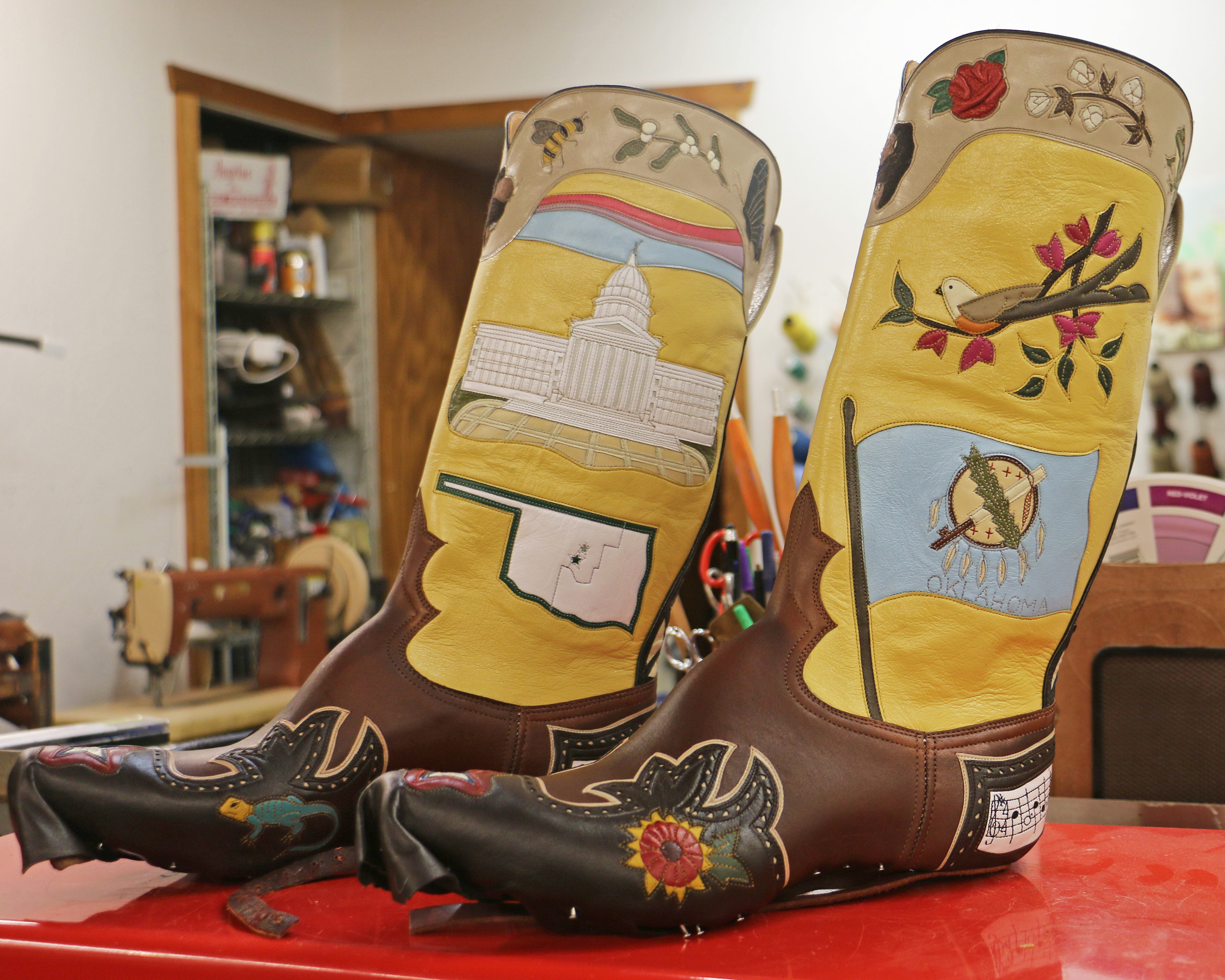
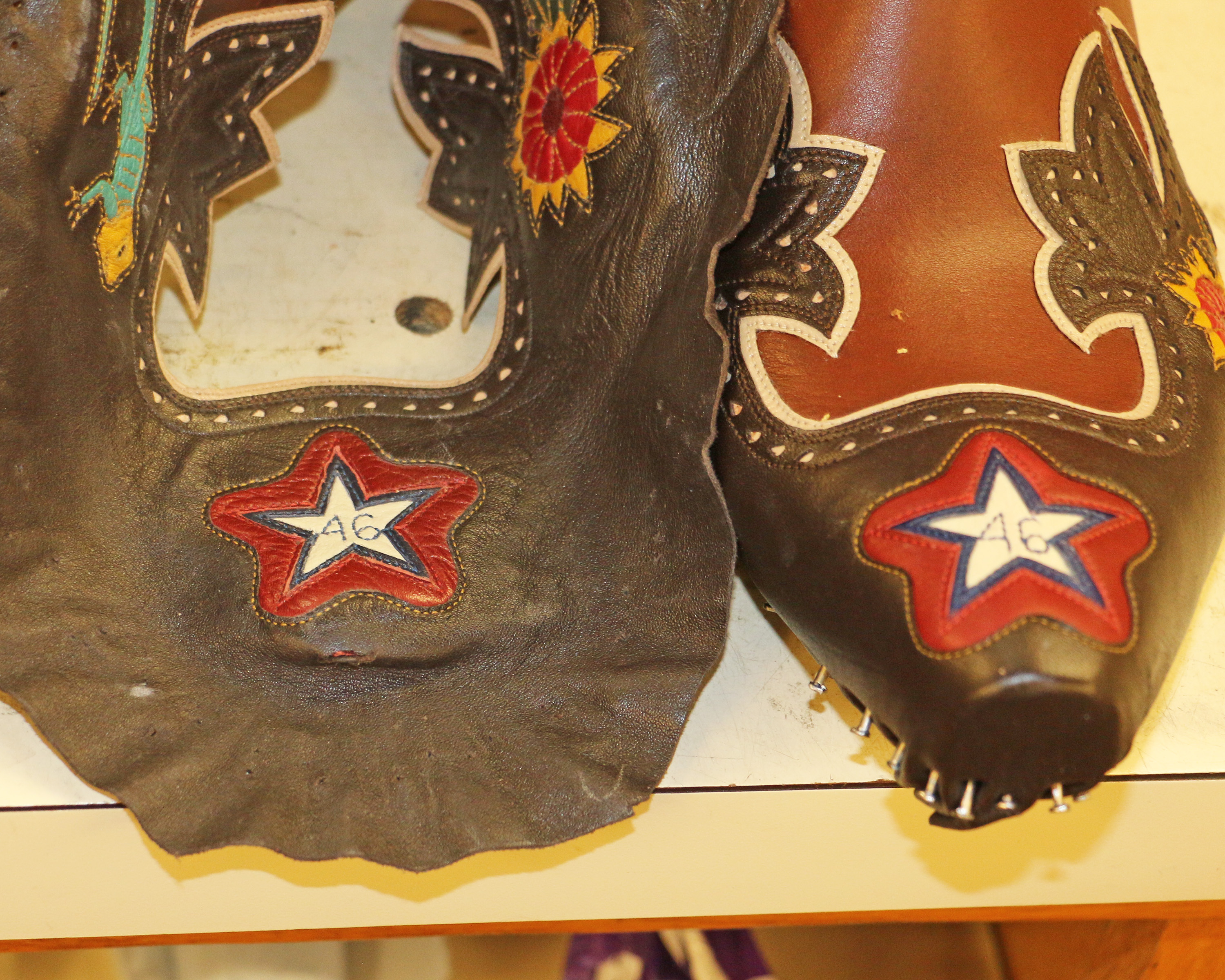
Before I continue that story, I’d like to point out another special little design detail. See the state of Oklahoma? The stitched line across it represents the line separating Indian Territory on the east side and Oklahoma Territory on the west side. Guthrie, the town where I live, was the capital of Oklahoma Territory and was designated the official capital when Oklahoma became a state in 1907. Guthrie remained the capital of Oklahoma until 1911 when the state seal was taken from the Logan County courthouse and delivered to Oklahoma City. This is why there are two stars on the map of Oklahoma; the smaller star represents Guthrie, the original capital, and the larger star represents Oklahoma City, the capital since 1911. 

After lasting the boots I wiped in the toe — the process that neatly smooths out all the excess leather in the toe area. I wiped the toe of the second boot, sat it down on my bench, turned away, and heard a THUNK as it fell off the bench and hit the floor. It fell directly onto the sharp corner of the toe and split the wingtip open. 
The leather I’d used for the wing and countertips was a piece I’d been saving for several years. I loved the color and the texture, and it was no longer available, but I decided this was a special enough project to warrant using it. My first thought was sheer panic because as I remembered it, I’d used up all of it. I went and dug into my scrap box and found (to my relief!!!) that I had one small scrap left exactly big enough to make one more wingtip. The boot fell off and split the toe open at 10am; I spent the rest of the day taking the boot off the last, carefully picking out the stitches and removing the damaged wingtip, making a whole new wingtip, carefully sewing it onto the boot in precisely the same place so no stitch holes would show, and lasting the boot again. I remember sitting down at 5:38pm with a huge sigh of relief to be back where I’d started at 10am. 
Two boots! With two undamaged toes! For as long as these boots were in my shop after this, I remained terrified of dropping them. When I delivered the boots to the Capitol, I told them this story and specifically noted with great relief that they were no longer my responsibility.
Posted in boot maker, Cowboy Boots | Tagged , , , , , | Leave a comment

Day Five, Oklahoma State Boots

Day Five: the making of the Oklahoma Boots, which are now part of the Oklahoma State Capitol permanent art collection

At this point in the process all of the decorative work is done and each piece is completed; now it’s time to begin putting all the pieces together.

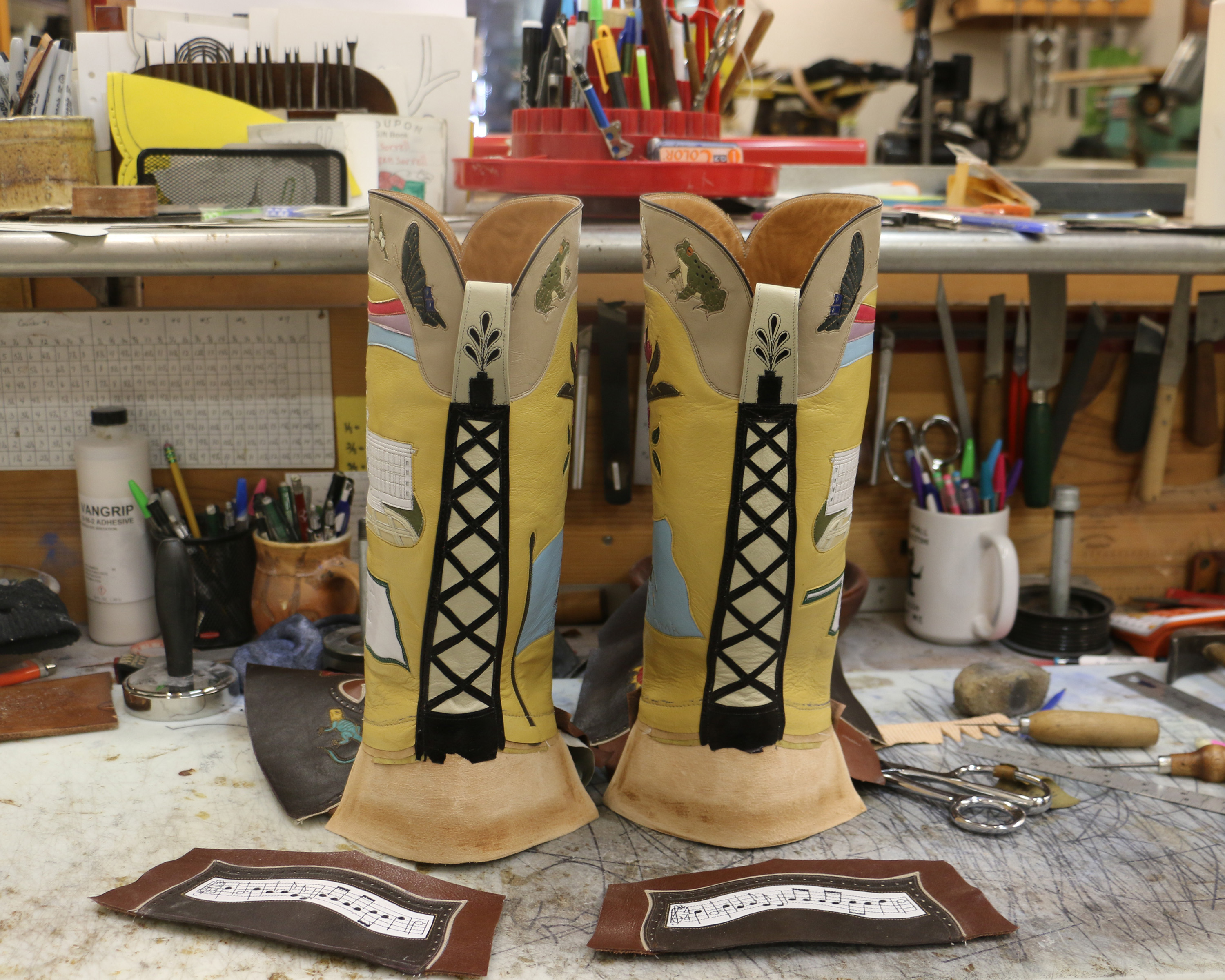
Making a pair of one-piece top boots with  a single seam up the back is a challenge. Here I’ve sewn the vamp tongue onto the boot top; this concludes the easy part of the construction.     
The challenge begins once the back seam is sewn — from this point forward I’m working with a tube shape. The absolute hardest part is sewing the thick, heavy, flat counter (heel reinforcement) into the boot. It’s done in this photo and you can be sure I was breathing a sigh of relief at this point.
That center back seam can be an ugly eyesore and it’s typically covered with a simple strap of leather. I decided to use it as an opportunity for another design detail, so the back strap is an intricately inlaid and stitched oil well. The Oklahoma State Capitol building is the only capitol in the world that sits over an oil well and the only US capitol with active oil rigs on the property.
The most common question about these boots is, “What size are they?” There are two answers: One, they’re a size 10B. And two, no, you won’t ever get to wear them. 
Posted in boot maker, Cowboy Boots | Tagged , , , , , | Leave a comment

Day Four, Oklahoma State Boots

Day Four: the making of the Oklahoma Boots, which are now part of the Oklahoma State Capitol permanent art collection

Today I’m going to talk a little bit about the wing and counter tips and their design inspiration.

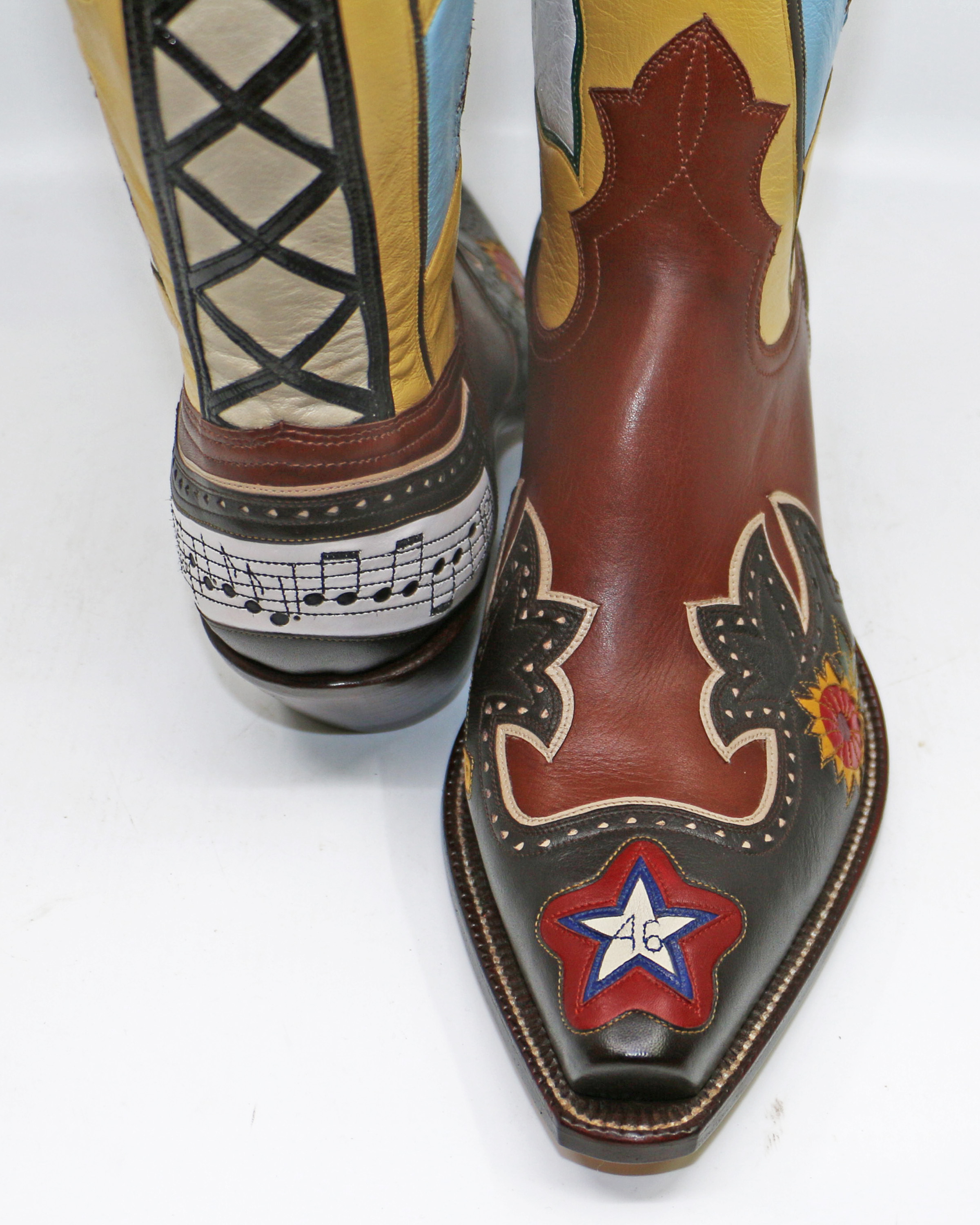
The countertip is the design part that goes on the heel area; it features the first line of Oklahoma’s official gospel song “Swing Low, Sweet Chariot.” This song was written by Wallace Willis, an enslaved Oklahoma man. There were dreams of Oklahoma becoming an all-Black state — a place to be free and own land and escape the shattered dreams of Reconstruction in the south. Oklahoma has many historically Black towns and is also home to Langston University, a historically Black college that opened in 1897. The counter tip is in memory of the many Black Oklahomans who sought freedom here.

The wingtip is the decorative part over the toe. A traditional boot making technique is a line of little round holes along an edge; these are called perforations. If you look closely you’ll see that the perforations on the wingtip are teardrops. This is in memory of the Trail of Tears, the forced removal of over 60,000 Native Americans from their homes to Indian Territory, which is now Oklahoma. The teardrops honor the ones who died on these marches, and the ones who survived.

Posted in boot maker, Cowboy Boots | Tagged , , , , , | Leave a comment

Day Three, Oklahoma State Boots

Day Three: the making of the Oklahoma Boots, which are now part of the Oklahoma State Capitol permanent art collection
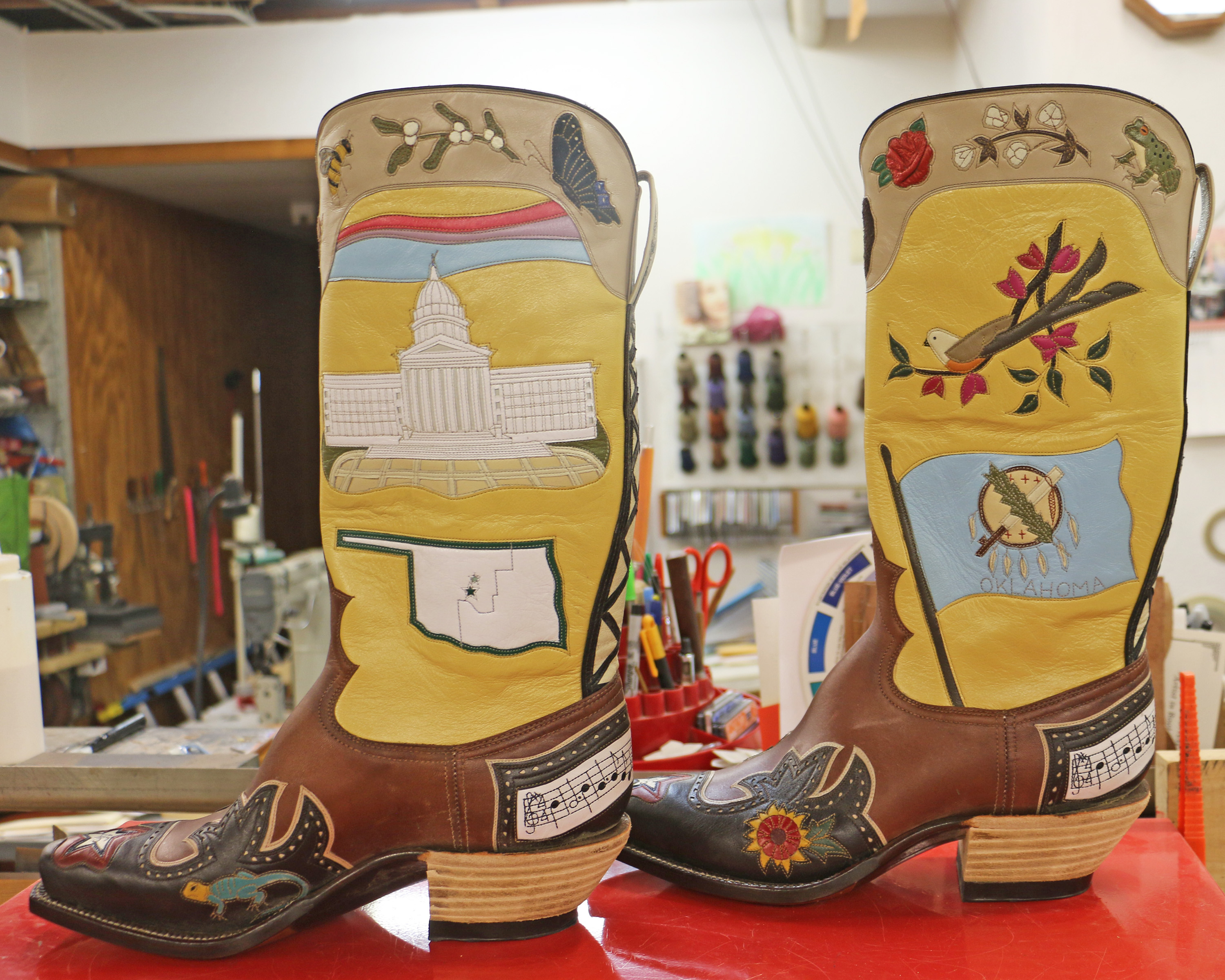
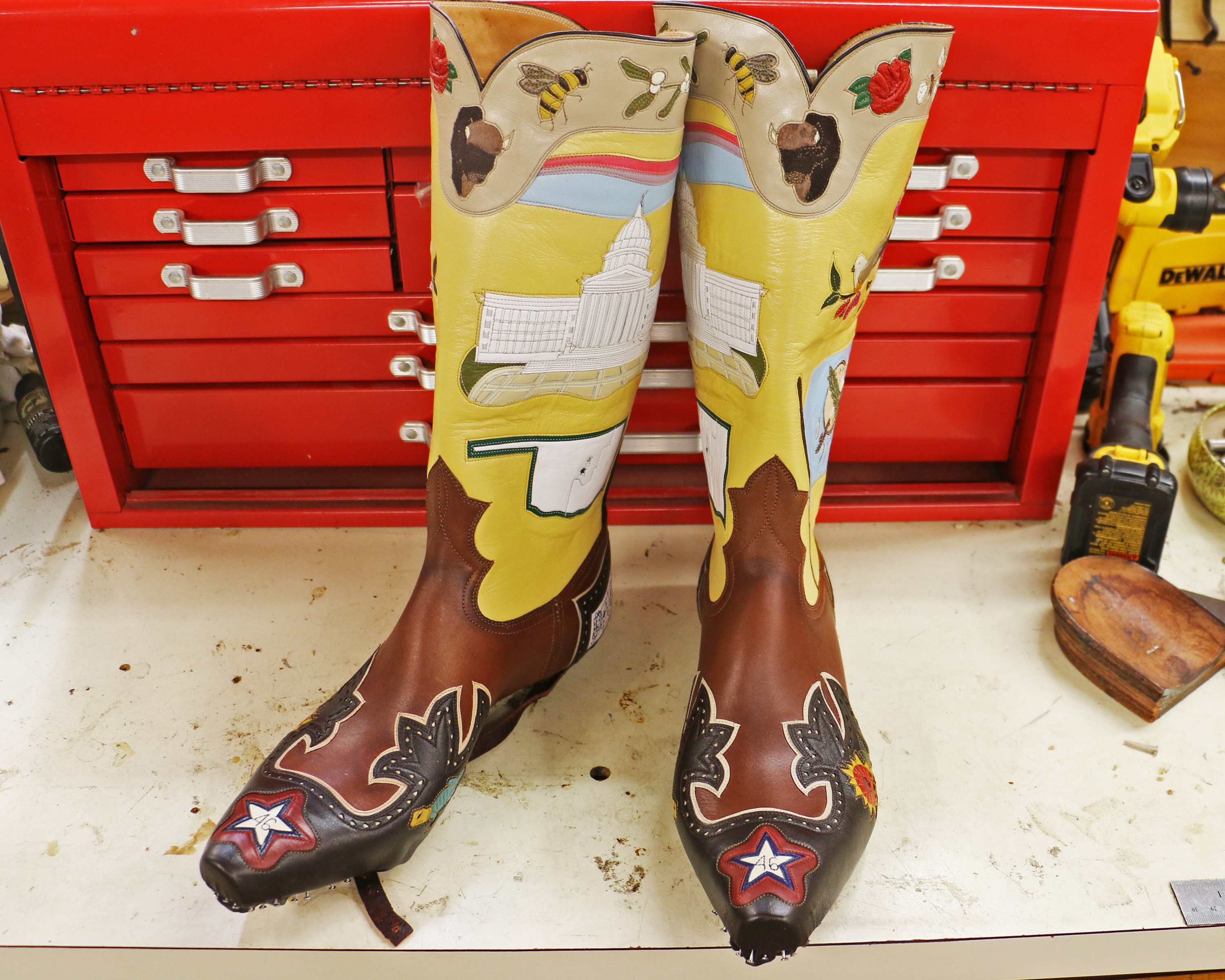
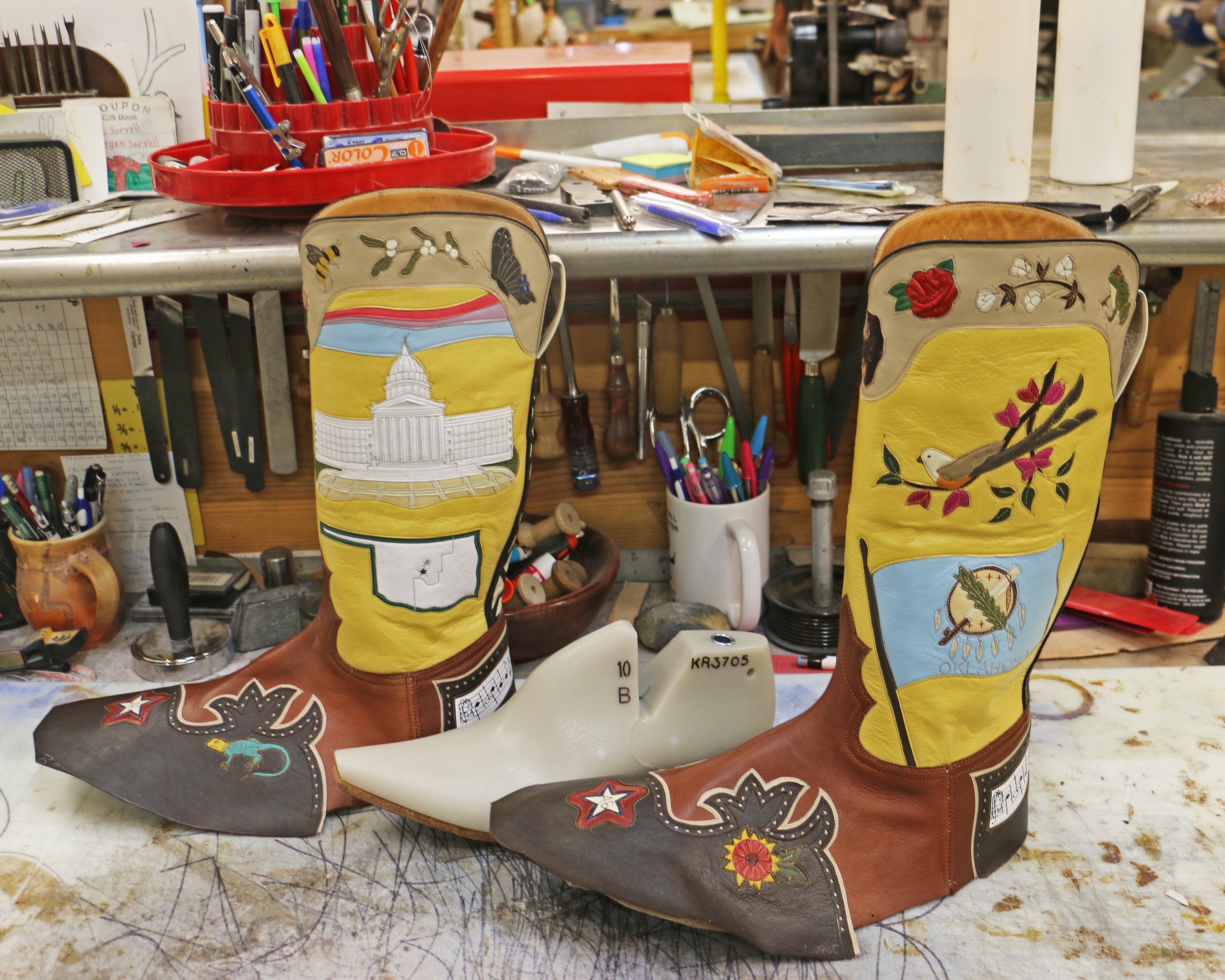
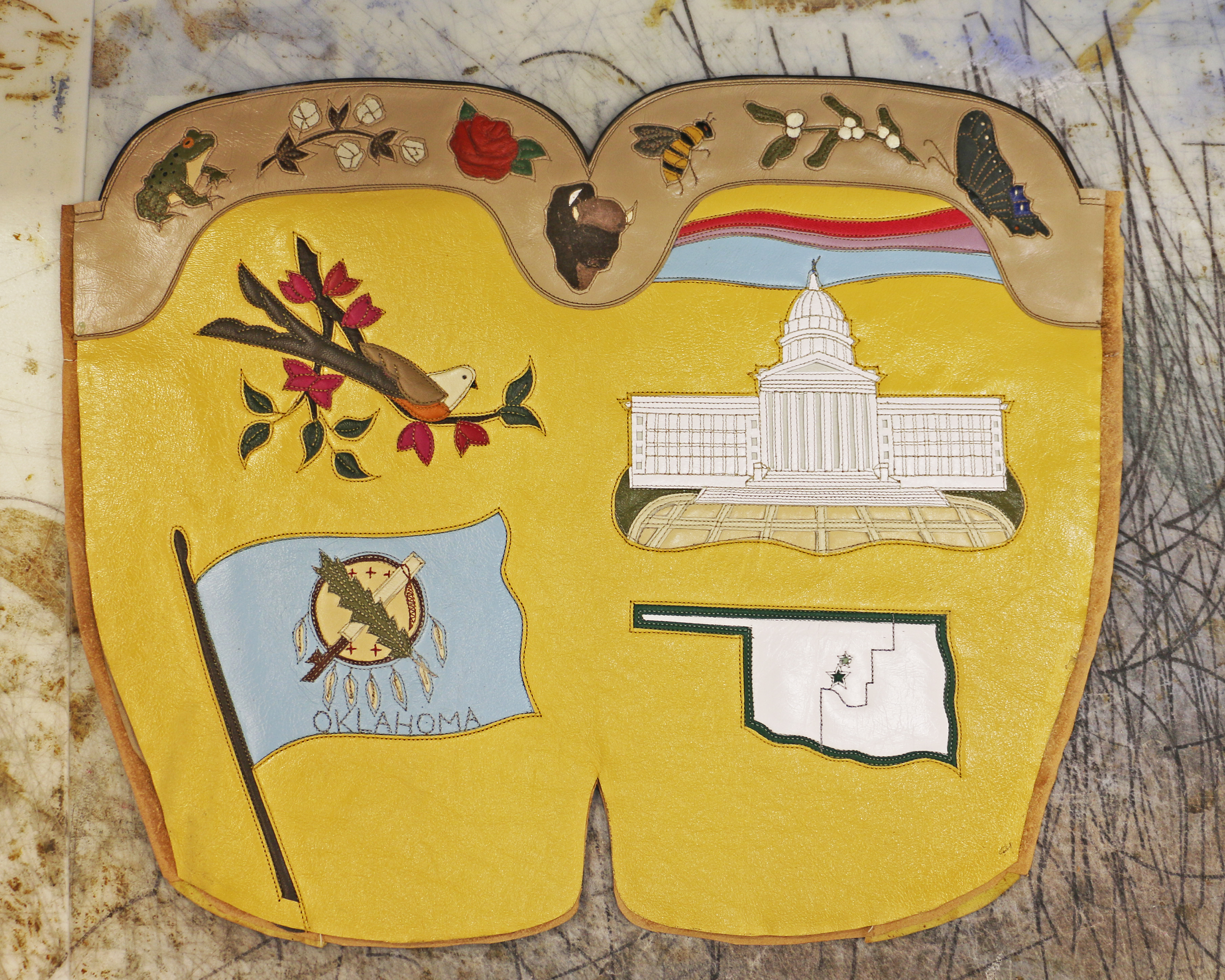
A one-piece boot top is one big panel of leather; the only seam is designed to go up the center back. Stitching lots of tiny details on a one-piece boot top is not too much fun because the piece is too big to fit easily through the throat of a sewing machine, and decorative stitching requires much repositioning of the work. For this reason I did as much of the stitching as possible before sewing it all together.
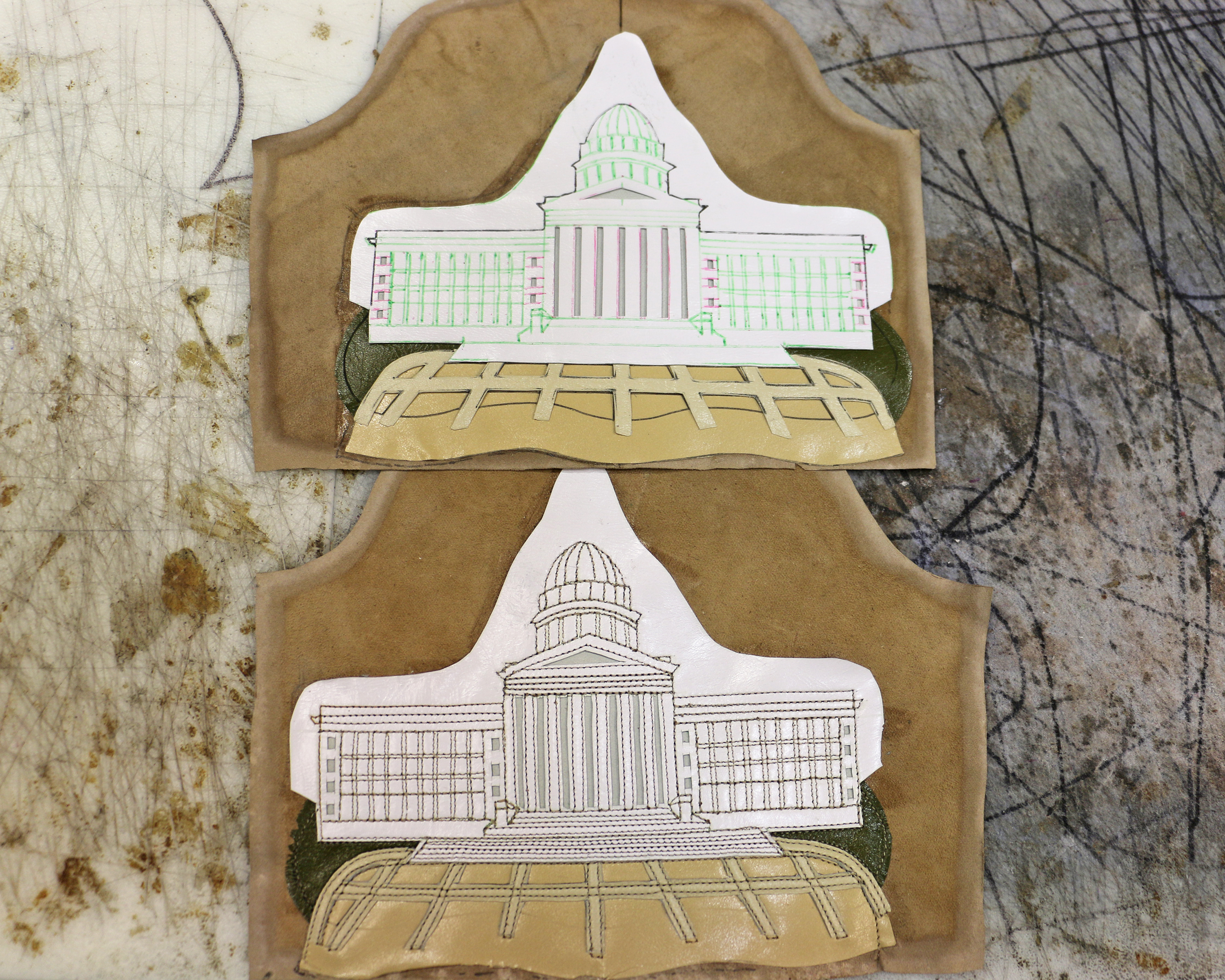
The Capitol building caused more mental anguish than any other design element. Straight lines are the most difficult to cut accurately and they’re the most difficult to stitch also — any small wobble is noticeable. I had never completely stitched a design element before adding it to a boot top, and I spent considerable time stressing about cutting the hole for this element exactly precisely the correct size and shape so it would fit perfectly around the stitching.
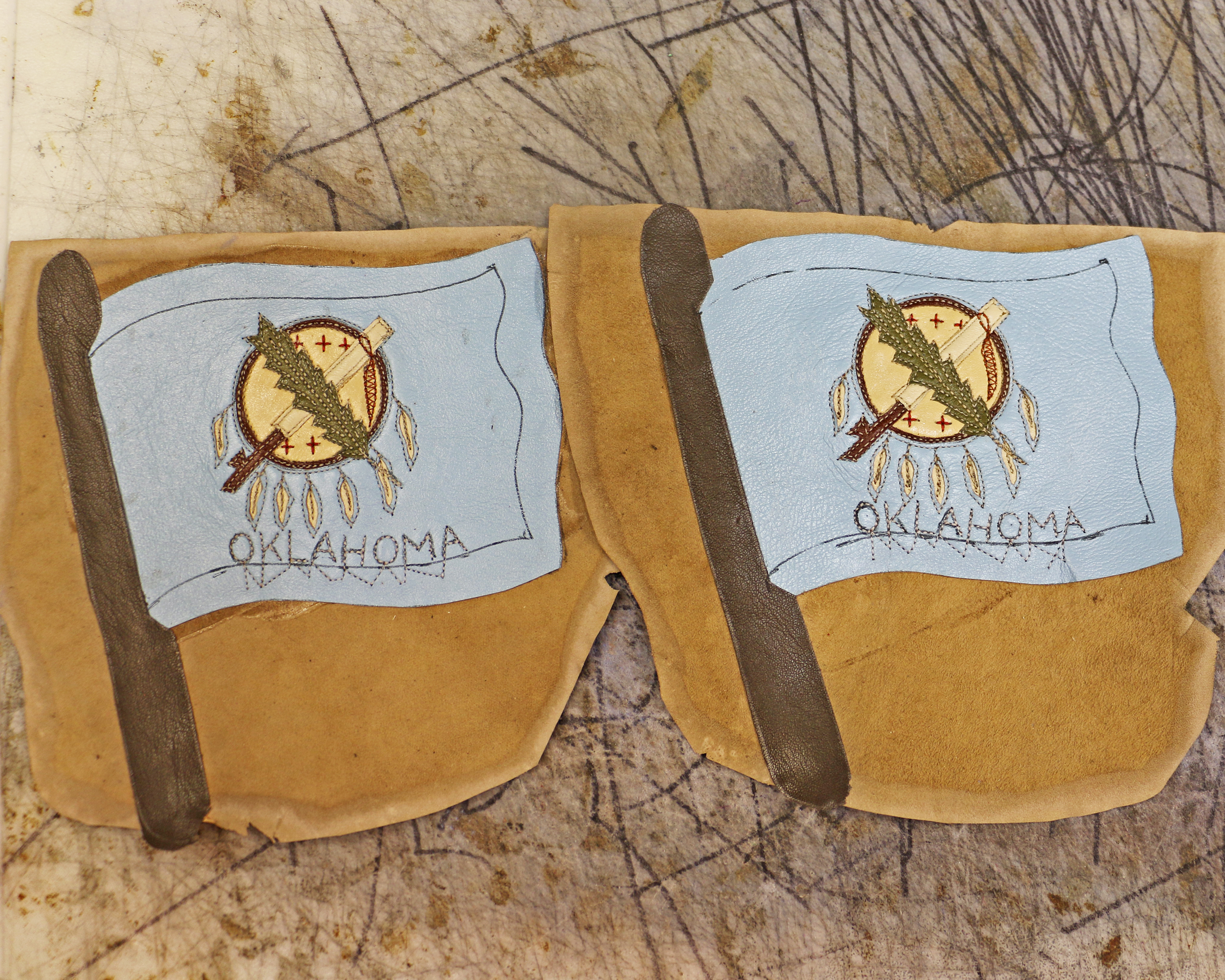
I also inlaid and stitched the Oklahoma flag before putting it into the boot top. The shape of the flag was easier but I wasn’t really confident I could do this much detail (and letters!) at this size. The day I successfully completed the Oklahoma flag was a good day.
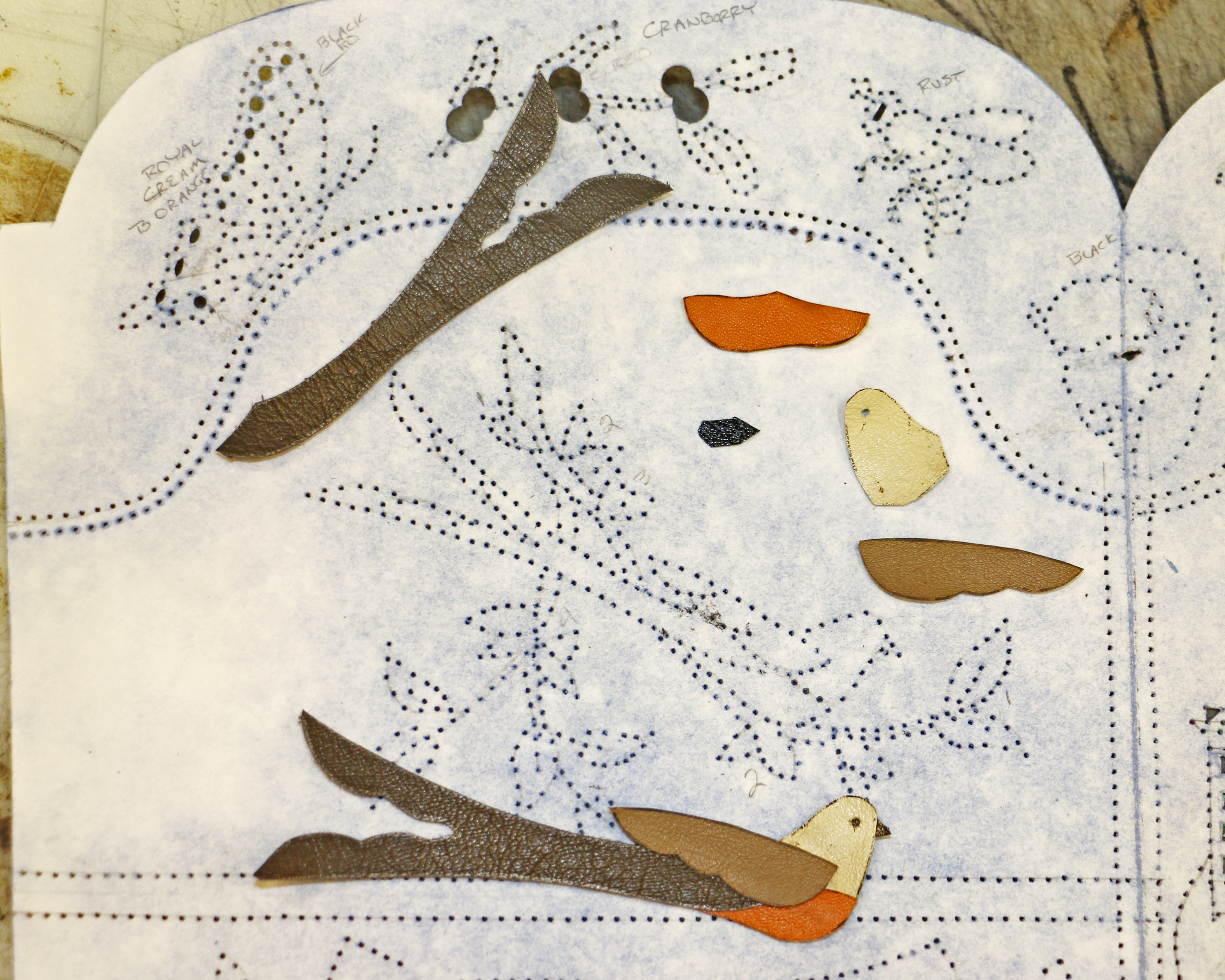
On the other hand, that sweet little scissor tail bird was a joy to create, and makes me happy every time I look at it. I’m going to create a framed art piece of the scissor tail on a redbud branch just so I get to make this part of the design again.
And just like that, the boot tops are completed! At this point I moved on to worrying about sewing that back seam — there’s a point with one-piece tops where you’re trying to sew things onto a tube shape and it’s not always easy.
Posted in boot maker, Cowboy Boots | Tagged , , , , , | Leave a comment