What should I do while waiting for toe boxes to dry? Start another pair of boots, of course.
Here’s a close-up of the new boot project. I made up this technique but so far have failed to also make up a name for it, but what I’ve done is stitch the negative spaces behind the design rather than stitching the design itself.
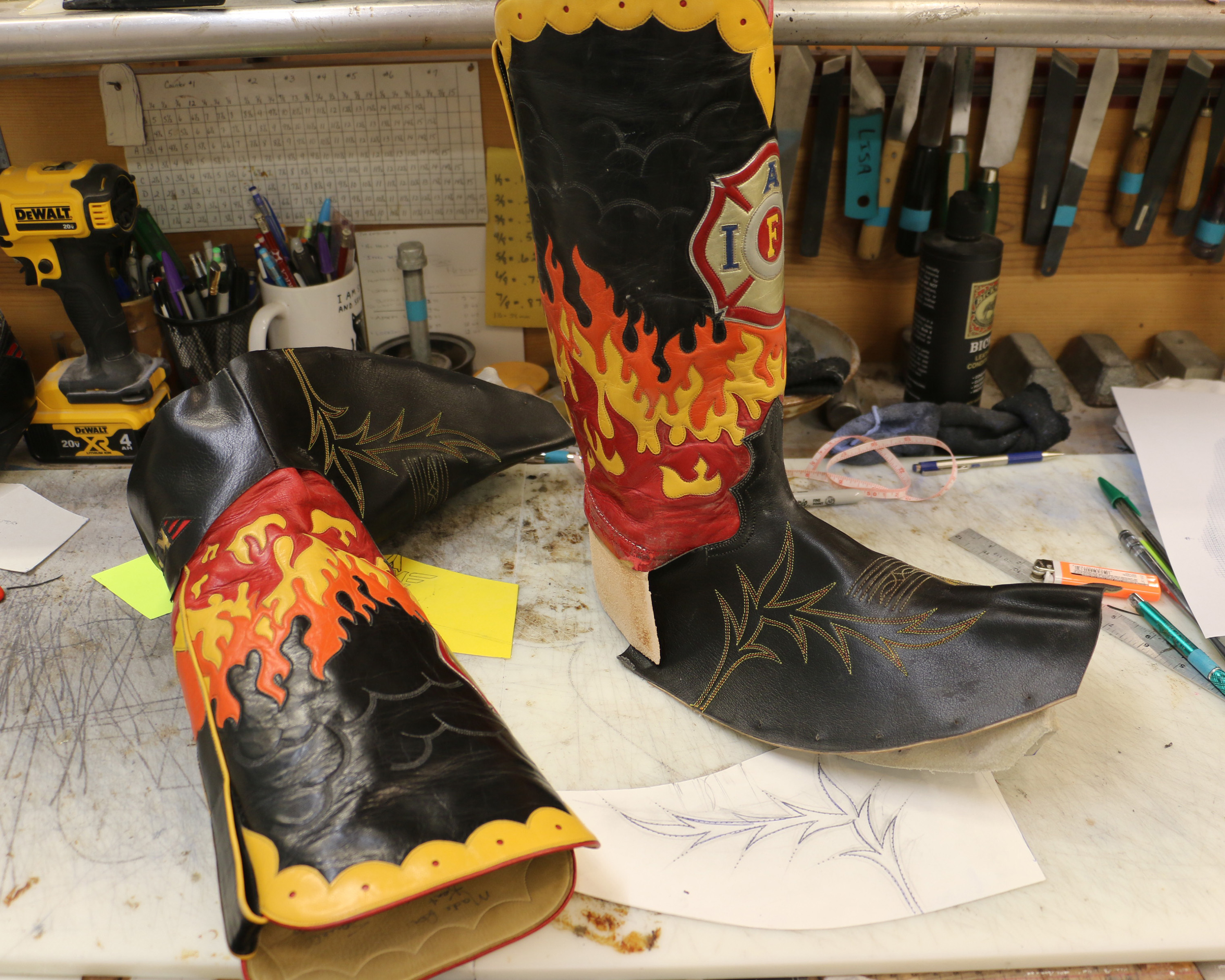
I’m in the middle of completely re-footing this pair of boots that I made in 2002 for a firefighter. These boots feature a one-piece top; instead of a seam up each side of the boot there’s a single seam up the back. It requires a whole different set of patterns and the challenging part is sewing the hard counter (heel piece) into a tube. This is difficult because the counter isn’t sewn flat onto the back panel. Instead, it’s “sprung.” In this case means that the center back point of the counter is forced higher onto the back panel than it would normally sit, which pulls the back panel into a curve. Trying to hold the counter in place while sewing up inside a tube is not a whole lot of fun, but once it’s done the work goes back to Difficult Level instead of Extremely Difficult. (One piece tops are never Easy Level.)
Edited to add: I forgot to note that the book is 10% off until June 23!
“Uppermaking for Bespoke & Orthopedic Shoemakers” by Hartmut and Dustin Seidich is now available for preorder. This is a book of patternmaking for footwear, explained in detail on 300 pages of easy to follow instruction and illustrated with hundreds of self-explanatory photos and drawings. Use for making well-fitting uppers for elegant, bespoke shoes and functional orthopedic footwear. The book is being printed now and I should have them in stock by mid-July. The website will allow you to order the book but it will notify you that it’s backordered. As soon as I receive my shipment of boots I’ll send out backorders.
These boots will be in Nashville next week and I’ll probably be carrying them around like an awkward proud mother so if you want to see them let me know.
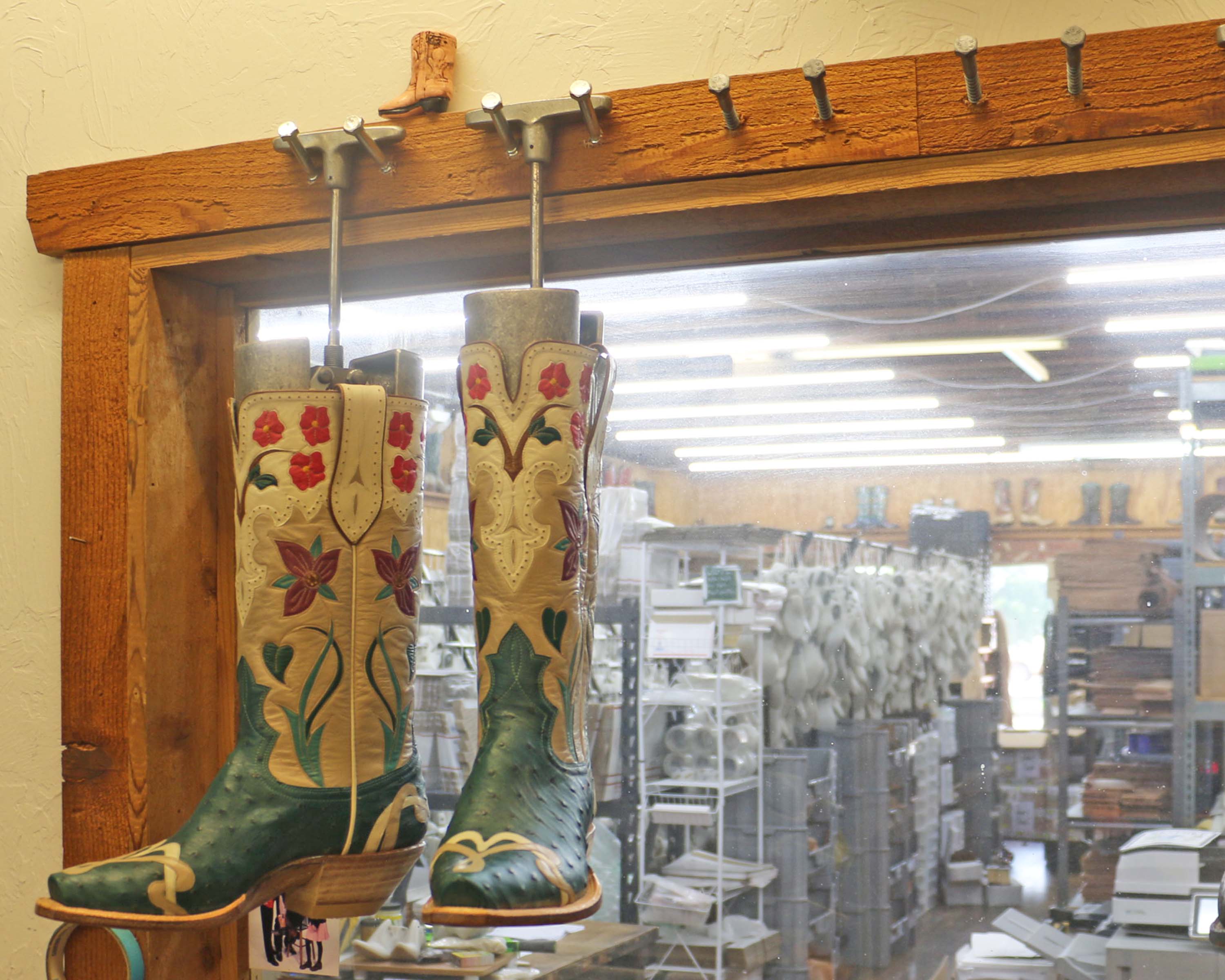
I’ll let these boots sit on the trees overnight, or possibly a day or two, but soon I’ll take them down, polish them, sand smooth the pegs that are sticking up through the insole, and they’ll be done! The soles and heels are going to be natural. They’ll be a little darker because I’ll put Bottom Stain on the leather before polishing and that will make the leather a deeper, richer color.
When you put the soles onto the boots, they’re “layed.” Stitching the sole to the boot through the welt is the “stitched” part, and then after you put in a double row of wood shoe pegs the soles have been “pegged.”
It always makes me a little bit happy and a little bit embarrassed when these boots appear online. Here’s the story: I started working for legendary boot maker Jay Griffith when I had just turned 21. I had no experience with cowboys, western wear, making cowboy boots, wearing cowboy boots, nor any comprehension of traditional cowboy boot designs or themes. Jay was often drunk and one day when he’d had a few too many, we needed to start a pair of boots where the customer had requested a prickly pear design. Jay told me that much, instructed me to draw a prickly pear design, and retired to his office.
I’d never seen a prickly pear.
This part of the story will betray my age — I’m pretty sure I walked to the library and looked in an encyclopedia for a picture of a prickly pear. Perhaps I’d seen a photo of someone else’s boots with prickly pears? I really don’t remember. Lacking any sort of ability to draw a design or understand how a design should be drawn, I simply used one of Jay’s existing floral designs and stuck a prickly pear on top of it. I’m not sure Jay was impressed but he was either too drunk or too amazed at my design to argue.
And that is the story of how these “magically weird” (as described by Jennifer June) boots came to be. They are now owned by boot collector Mark Fletcher, and the photo credit is his also.
I woke up yesterday and my thumb was hurting, which always sends me into an instant spiral of worry and sadness. But it feels better today and still feels fine after inseaming! I want to finish this pair by next weekend so I’ll hope for healthy hands and generous time in the shop.






 Lisa Sorrell, cowboy boot maker