I'm a custom cowboy boot maker. I own a business, Sorrell Custom Boots, and I create bespoke cowboy boots using vintage machinery and hand tools. I also own www.sorrellnotionsandfindings.com, a company that specializes in tools, supplies, and leather for the boot and shoe making trade.
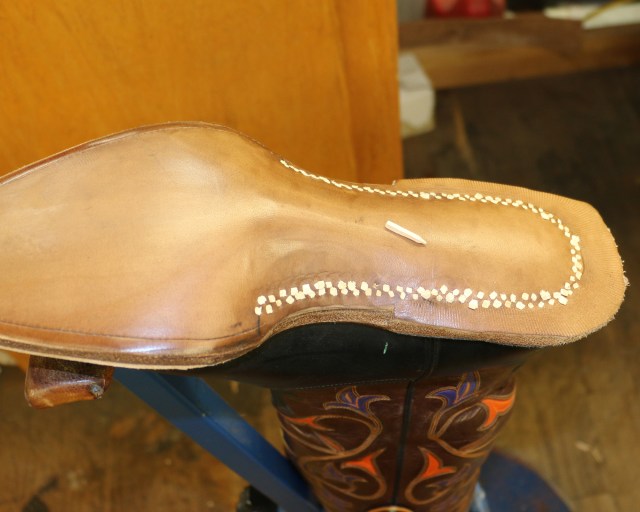
Fascinating! I’m curious: what is the function of the wooden pegs? Are they simply “traditional”, or are they the only way to do the job, or better than alternatives?
It’s a combination of things. Yes, a pegged sole is traditional for cowboy boots.
Historically, the glue used to attach soles to a boot or shoe was not strong enough to hold the sole on alone; that’s why the sole was also stitched on through the welt. (Today’s glues have a much stronger bond, but we still stitch and peg.) Men’s dress shoes are typically stitched from the front of the heel all the way around the front of the heel on the other side. Cowboy boots can be done that way as well, but since they have a higher heel, it was discovered that pegging in the shank area instead of stitching reinforced that area more and made it stiffer and less flexible.


 Lisa Sorrell, cowboy boot maker
Fascinating! I’m curious: what is the function of the wooden pegs? Are they simply “traditional”, or are they the only way to do the job, or better than alternatives?
It’s a combination of things. Yes, a pegged sole is traditional for cowboy boots.
Historically, the glue used to attach soles to a boot or shoe was not strong enough to hold the sole on alone; that’s why the sole was also stitched on through the welt. (Today’s glues have a much stronger bond, but we still stitch and peg.) Men’s dress shoes are typically stitched from the front of the heel all the way around the front of the heel on the other side. Cowboy boots can be done that way as well, but since they have a higher heel, it was discovered that pegging in the shank area instead of stitching reinforced that area more and made it stiffer and less flexible.
Thanks for a very well-written explanation!